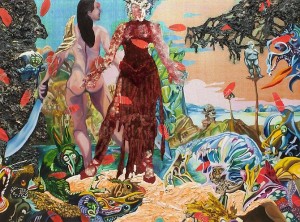
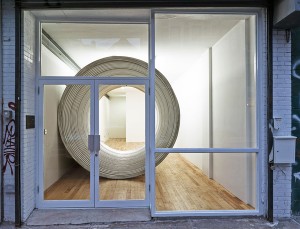
“Migration” is interesting less for its nomadic creators or themes than for its focus on the perceptual refractions of the physical, often-feminine and unstable body.
For all its faults, Kraus argues, the “art world remains the last frontier for the desire to live differently.” The claim is ambitious.
There is a wide range of depth and quality in this show, interesting for the prevalence of two kinds of fin-de-siècle themes: one, an obsessive kind of cataloguing reminiscent of the 19th century Decadents; the other a knowing, overly personal, faux-folksy, quasi-naïf intimacy that recalls the end of the more recent century.
The obituaries, one feels, are all wrong. As though the death notice of one so avidly alive could be anything but. “Caribbean militant”, “Martiniquan writer.” I suppose he is those things, journalistic shorthand for a man who explained to us, its makers, just what the world could be.
The exhibition succeeds on many levels, though too often it’s maddeningly difficult to decipher how many of these successes are intentional, despite Hart’s wordy description. It’s beautifully arranged, with a consistent logic that prizes thoughtful details and careful spatial pacing. Hart is canny enough, for instance, to have our first encounter be Allen Ruppersberg’s “thank you, mr. duchamp. would you close the door please? thank you.” which is affixed to the wall in such a way that you do, in fact, have to open it. It’s the kind of hands-on, witty engagement with the audience that made this period of sculpture so engaging.
If space and depth are displaced (or misplaced) in Diernberger’s work, in Rehana Zaman’s Diagram of an Event, the time, as Hamlet said and Deleuze echoed, is out of joint. A diagram of time, reducing four dimensions to the representational two, destabilizes itself, undoing its own order and rationality even as its mode of communication is implicitly described as an attempt to impose order and rationality. It’s an impossible diagram of the intangible.
This is complemented by the diversity of genre and medium, both between the works and within them. Carlos Roque’s digital print Mundo Moderno no. 2 is a good example of this confluence: a jumble of precise, draftsman-like drawing, overlaid with varieties of text—graffiti-style, signage, and so forth—presented in both anterior and mirror image, so you’re never quite sure of how deep the work wants to take you, dimensionally speaking. Sharp lines thrusting at various angles through the frame, and variously scaled vehicles add a dimension of movement, and thus, also, of time, to the assemblage of directions.
Here there are at least twenty negatives dedicated to a couple lunching in a plaza—with the woman out of the frame. The minute changes in the man’s facial expressions tell a complex story. Each negative could have yielded a different set of photos with its own physical life and a very different narrative. Very rarely does one take so many shots on the digital camera—the physical experience of clicking away, unaware of what shows up until the film is developed, has nearly ceased to exist, and we feel its loss here. One wonders which image the photographer would have chosen as the “right” one, the singular, defining image, had the photo’s journey not become a Borgesian garden of forking paths.
In pictures like Weißer Fiat-Bus (White Fiat Van), and Grüner VW-Transporte there is a regrettable surfeit of what I always think of as ‘serious-memory-light,’ a sort of aggressively mellow, late-afternoon-inflected, golden tone that is just desperate to be described as “evocative” but comes across as intensely maudlin. This sentimentalizing tendency is evident in other heavy-handed touches: the repeated use of a grey-on-grey theme, the mists, the path-heading-into-mysterious-woods motif, the way the gaze lingers on the beginnings of rust around a window frame.

Anj Smith, Reconstruction, 2010. Via Hauser and Wirth
When I was a child, a cheap print of the Mona Lisa hung in my father’s studio. Along with Picasso’s The Musicians, it is the first thing I remember staring at for hours. I didn’t pay any attention to the lady or her (insert preferred adjective here) smile until many years later: instead, I was obsessed by that marvelous background. The collapsed perspective – of looming mountains, or craggy, thimble-sized castles, and serpentine roads leading to nowhere, cradling a fantastic, calm sea – looks different in every print I’ve seen.
The occasion for spilling virtual ink on the Mona Lisa is Anj Smith’s Geometry of Bliss, currently at Hauser & Wirth on the Upper East Side. According to the gallery, Smith’s painting, ‘R.’, “depicts a close friend of the artist as a 21st-century Mona Lisa…an enigmatic figure…Neither a woman or a man, R. is instead a person suspended in transition.’ The nominal subject is exquisitely complex, drawn with a kind of old-Masterly care and minute attention to detail, looming large in the Renaissance proportioning of the canvas. The suspension between genders is readily apparent– what, quickly scanned, appear as Rapunzel-like tresses may in fact be sort of Edwardian sideburns. The delicate face is overpowered by a heavy nose, somewhat mashed down the middle like a prizefighter’s. The figure’s arm is almost definitely male– or at least, muscled and hairy as it is, it bears the visual hallmarks of maleness. The gender division is echoed by the human/animal division: what look to be a tiny possum, a squirrel, and something vaguely sloth-like nestle in the figure’s hair, part of an inward-curling spiral that ends near the navel and sucks in every object depictd, including the glowing green sea.

Anj Smith, R., 2010. Via Hauser and Wirth
As before, I was utterly captivated by that background, unequivocally apart from and unknowable to the subject, yet inescapably drawn into the structure of the work by Smith’s careful composition. The very specific sea-green (it looks like an amped-up version of the Crayola color) is by far the brightest and, emotionally, the deepest color in the painting; a single moment of openness and vulnerability. Its fragile centrality and essential opacity are highlighted by the object in its center, either an upward-reaching branch, grounded in nothing, or a downward-shooting lightning bolt, stemming from nothing.
Anj Smith’s paintings (the word is inaccurate, or at any rate insufficient: they are sort of more than paintings, or other than paintings, but more on this later), have been described as “extravagantly detailed magic realism” (by the gallery), and as “self-consciously mannered Gothic-Surrealist” (by Martha Schwendener, in the Times). In fact, neither of these convenient catch-all labels, whose ubiquity threatens to render them meaningless, really applies, nor is this kind of grabby academicization really necessary. Smith’s exhibition is a lot of things, but what these portentous phrases are gesturing towards is its most basic quality: a marvelous weirdness permeating her images, their textures, and the somber tonalities of her figures’ delicate physiology.

Anj Smith, Evolution in Poetic Language, 2010. via Hauser and Wirth
That said, tentacles of surrealistic expression are everywhere in this work, with differing manifestations. The first of the small-scale renderings, in a gallery almost by itself, is Reconstruction, and it calls to mind Kahlo’s doubled self-portraits, turning the body inside-out and destabilizing its subjectivity. Here, a figure reclines, its pose reminiscent of an Ingres Odalisque. The head of this quasi-feminine figure, crowned with an unsettlingly organic sort of Renaissance bouffant, is vaguely Elizabethan, the dueling references conflating time and genre. This generic, thematic and physical superimposition-by-suggestion happens repeatedly, in various iterations, in almost every work. The referentially-layered, inside-out body is apposed, almost lazily, by a form that repeats throughout the show: a sort of hanging, roundish amalgamation that manages, somehow, to assert itself as a subject. On closer examination, the mass consists of perfectly drawn rats within what appears to be an enclosure of barbed wire. Because of their positioning and the emotional dialogue generated therein, each of these two very different constructs holds its own, confounding what is expected, or even permitted to constitute a subject: animal, human, gender—the divisions are craftily and cannily confused.

Anj Smith, Social Science, 2010. Via Hauser and Wirth
Smith’s Evolution in Poetic Language is, in some ways, exactly that. The dual presence of two vague subjects move in a less literal direction than the precise figures of R. or Reconstruction. Here the main figure, suspended luridly from some kind of apocalyptic clothesline in a crepuscular sky, is almost frightening, a face-like orb draped in the gauzy, tattered veil that also appears repeatedly. Composed of pop culture references and arbitrary memories, it evokes a self by shaping its components into the gestures of a face. That “clothesline” attaches it to another, more abstract face, as though the artist is moving further towards abstraction with the creation of each subject. Evolution in Poetic Language is, like the other works, more than a painting, in the sense that it refuses to stay flat. Smith layers paint to such a degree that her linen canvases take on a dimensionality and complexity reminiscent of a coral reef. This sculptural quality, and its highly enameled, almost lacquered, finish, add another level (quite literally) to the engagement with surface, tactility and communication that the relating figures within the show evoke. The works are literally polished, totally finished. The strongest, somehow, are those, like Social Science that dispense with faces and figures entirely. The inscrutable pomegranate, pierced with feathers, and that meme-etic miniature branch/lightning bolt growing out of a crumpled cigarette butt gives the inky blackness of the canvas a compelling emotional intensity. Put another way, Smith’s best is even better when the figures step back and let the colors speak for themselves.