
-
Greg Afinogenov
-
After Twenty Years
by Greg Afinogenov September 8, 2011
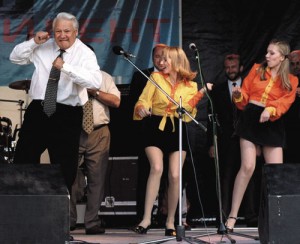
I eventually manage to ask: so, the anniversary of the August 1991 putsch is this month, are you celebrating?
-
Where the Masses Art: 4chan, Politics and the Electronic Id
by Greg Afinogenov October 19, 2010
The site’s userbase is almost entirely anonymous—but for its IP addresses, which 4chan’s founder admitted to keeping at a Congressional hearing—and constantly shifting. Threads, by site policy, are deleted permanently after a few minutes of inactivity; this means the site has no official archive or memory, unlike the rest of the Internet, which usually retains data forever. The place is moderated, but the admins restrict themselves to removing child porn and overt terrorist threats rather than, as with most other sites, hate speech and other outré comments. The result is a massive cesspool that has come to epitomize the electronic id.
-
Reflections on the Evolution in Russia
by Greg Afinogenov August 31, 2010
In early August, as the fires were taking on truly catastrophic proportions, a Russian LiveJournal user groused about how his village’s fire-protection system, set up under the Soviets, was dismantled by the “democrats” and replaced with a non-working telephone. The general editor of “Ekho Moskvy,” a well-known liberal radio station, forwarded the post to Putin. The prime minister posted a comment in response:
Dear User,
Today, at the end of the working day, breathing, like all Muscovites, the smoke from the fires burning around Moscow, I was very pleased to read your evaluation of the situation with the forest fires in Central Russia. […] You are, of course, a wonderfully sincere and direct person. You’re just great. And you are, unquestionably, a gifted author. If you were to earn your living by writing, you could live, like V. I. Lenin’s favorite author—A. M. Gorky—on Capri. But even there you could not feel yourself secure. Because both in Europe and the USA natural cataclysms on the same scale are being confronted. […] Despite all the problems and difficulties, I hope that you and I will be able to get to retirement successfully. -
Shelf Life: Berlin at the End of History
by Greg Afinogenov July 16, 2010
These buildings, of course, no longer exist in their old context. Today, they function as tourist destinations, as members of a long list of “sights”—from concentration camps to dance clubs—that visitors to Berlin are expected to see. Yet something in them remains unsettled: as the Roter Saal reminds us, they exist as spaces out of joint with their time, subsisting uneasily as links to moments that are not simply outdated but, in effect, unassimilable. They provide us with an opportunity to question not only how the city copes with such irruptions of anachronism, but also the conditions of their apparent necessity. We need these places, but we don’t know why.
-
The Poverty of Privacy: Google, Facebook, and the New Jeffersonians
by Greg Afinogenov June 4, 2010
It suffices most of the time to accuse someone of collecting information (search data, shopping patterns, demographics) for all the toxic bubbles of suspicion to float to the surface. Surely you’re not in the business of making money off of information? Why would you need so much information anyway? And can you really not tell if it’s me buying the Hello Kitty vibrators?
-
Materialism and Art-criticism: A Response to Ben Davis’ “9.5 Theses on Art and Class”
by Greg Afinogenov May 13, 2010
Were Engels to read Ben Davis’s “9.5 Theses on Art and Class,” written and circulated in early 2010, he would no doubt be shocked out of his complacency. He would immediately recognize, of course, the phrases that he and Marx had coined so long ago: “working class,” “relations of production,” “class interests.” Something of the style would also seem faintly like his own. Indeed, to Engels’s undead eyes the strangest expression would probably be “middle-class,” used by Davis, it seems, in place of “petty bourgeois.” Almost everything would be familiar—and yet everything would be strange.
-
A Portrait of Bureaucracy in Twelve Parts; Seventeen Moments
by Greg Afinogenov March 12, 2010
Viewed in this way, the film’s notion of bureaucracy and institutional structure appears quite unconventional. In the classic Weberian model, bureaucracy is characterized by meritocratic values, impersonal legal norms, and a particular kind of instrumental rationality; according to popular stereotype, bureaucracies are staffed by faceless functionaries and prize process over results. Yet here, the bureaucracy is defined precisely by the personal relationships that subsist between its employees. Its fault is not that it is too abstract or too by-the-book. Quite the opposite: bureaucratic politics in Seventeen Moments of Spring is quintessentially narrow-minded and myopic. It sins, in short, by refusing engagement with abstract questions.
-
Notes on Art and Ideology in Israel
by Greg Afinogenov February 1, 2010
The paintings revisit, again and again, the familiar touchstones of Israeli conservatism: religion, motherhood, military prowess, the return of the diaspora, the struggle for national survival. From their thematic arrangement a kind of total worldview emerges—self-sufficient and, no doubt, inspirational, but also ossified and incapable of change. None of the paintings even seem to acknowledge that Israel is a country undergoing rapid and unsettling transformations (which are symbolized, not least, by Azrieli’s own skyscrapers). Their most common visual idiom is a vaguely Chagallian, vaguely sentimental image of shtetl life, which serves only to illustrate the process by which an artistic style developed by the marginalized and downtrodden has become the dead matter of institutional art.
-
The Apparatus as Artist and Spectator
by Greg Afinogenov December 15, 2009
Not the buildings but the whole impersonal network of social relationships that sustains the Party; carving out the tracks along which the passersby are always so determinedly marching.
-
The Ninotchka Effect
by Greg Afinogenov October 29, 2009
In fact, the line of filiation for The Lives of Others leads directly back to another, classic film. Ernst Lubitsch’s 1939 comedy Ninotchka. Ninotchka, set mostly in idyllic prewar Paris, is far from the life-or-death drama of Henckel’s Berlin. Here, the threat of being sent to Siberia is repeatedly played for laughs, and the only direct suggestion of the Great Terror is the titular character’s casual remark that it will lead to “fewer, but better, Russians.” In Ninotchka, however, we find the same ideological coordinates that would later be used to such great effect in The Lives of Others.
-
