
-
Max Carlos Martinez at Christopher Henry
by Stephen Squibb October 12, 2009

The images by Max Carlos Martinez now on display at Christopher Henry are a sort of provisional symbolic index of the American west, retraced and retitled by the artist. There are cowboys and Indians, but also miners and maidens, each christened with the name of a different popular song.
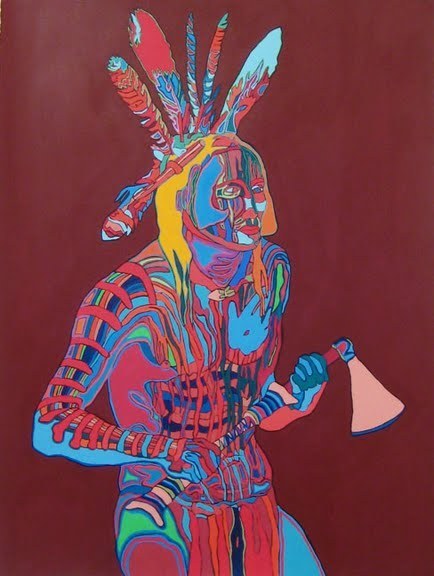
This choice of titles is interesting. At first blush it comes off as cleverness for its own sake, a throwaway gesture aimed at locating the work within a larger lexicon of popular culture. Cowboys are to image what the Beatles and the Rolling Stones are to sound. What prevents the choice from stalling is that the titles chosen are from contexts that are unavoidably from another place, British bands, say, or, in the case of L.A. Women, bear strong associations with specific locations. The resulting enjambment of different eras produces a striking alienation effect, with the mute and decidedly un-ironic images now marooned between their own time, that of their titles, and the present moment.
Two large, black-on-white tracings of multiple figures further rehearse this feeling of isolation. Each character seems almost to be floating in space, unrelated and unaware of the others, except when their action seems directed towards one of them as if by chance, as when a miner seems about to bring down his axe on a fallen cowboy. The works themselves seem formal echoes of an adolescent’s sketchbook or a sheet of stickers, with figures finding themselves in proximity to one another by dint of a haphazard necessity.
Unfortunately, too much of the show is composed of singular images that lack the constellated poignancy of these images. While these are sometimes executed with a striking vitality and eye for color, as in She Came In Through The Bathroom Window, too often they fail to distinguish themselves, and here the titling falls into precisely the tired sarcasm so nimbly avoided by the larger mural-type works.

